
Today we roamed, and I got my architecture fix. We started out just windows shopping, and exploring some of the offerings off of Catalunya Square. It was a beautiful day, and about 64 degrees. Christmas decorations are starting to appear, as is merchandise in the stores. It’s easy to forget it’s early November in this mild climate.
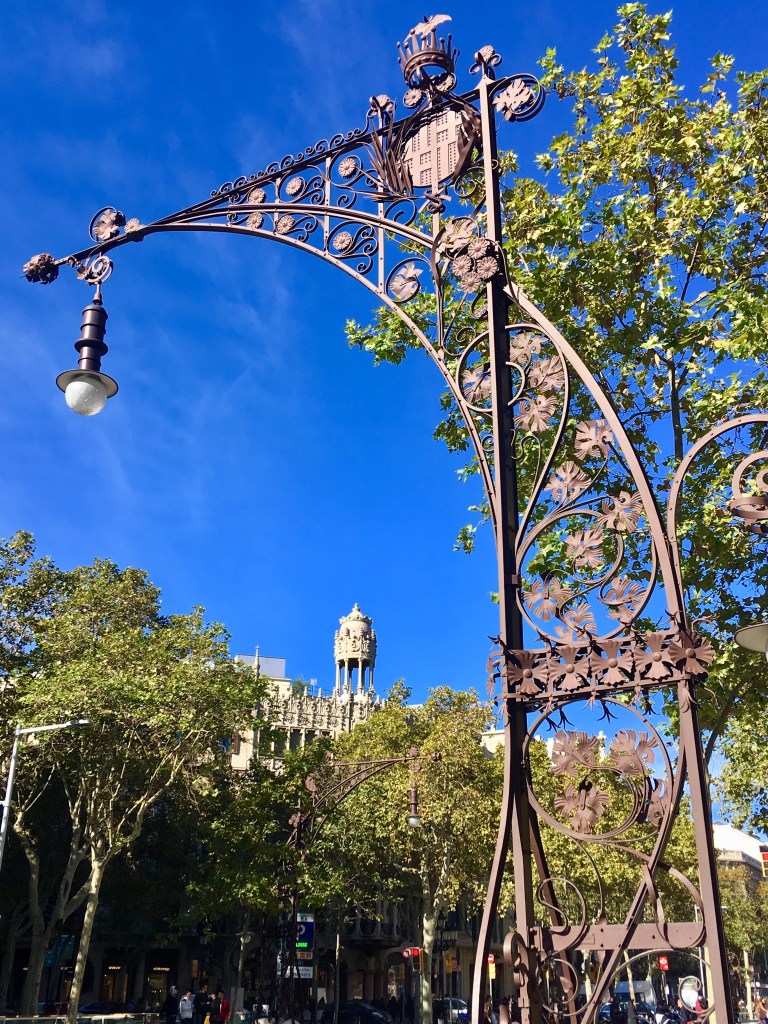
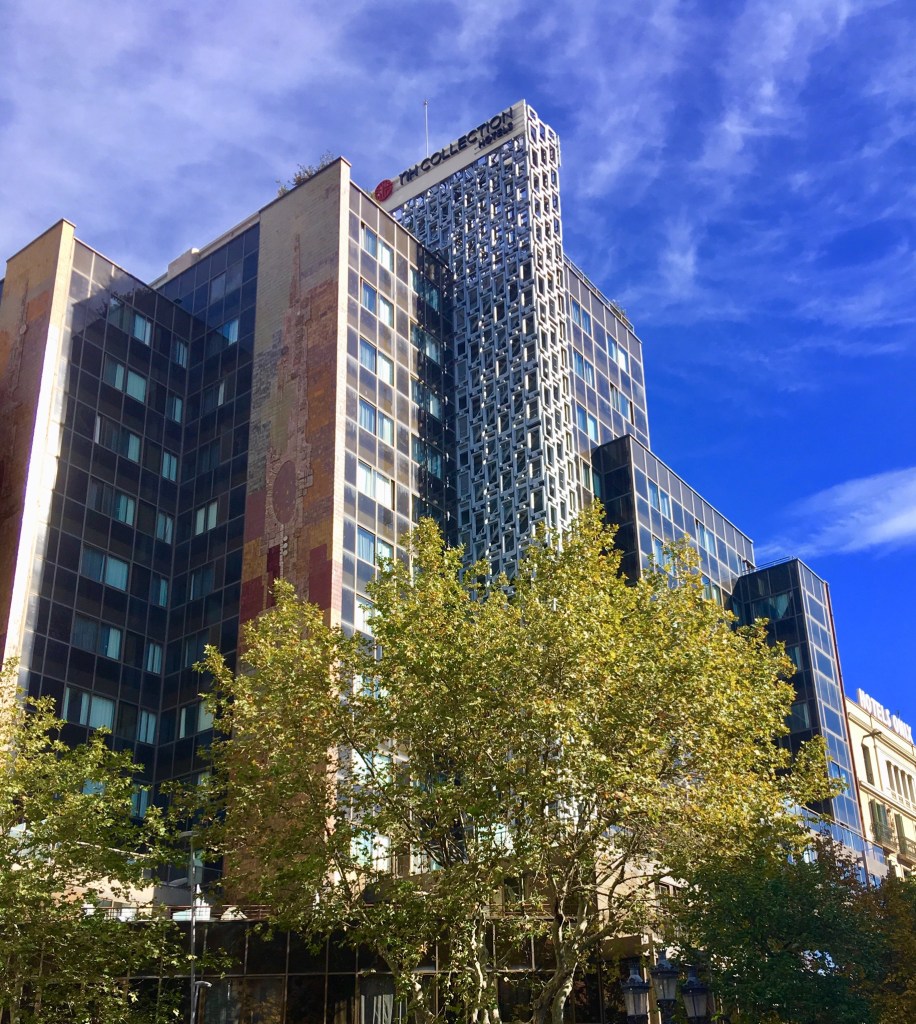
We ended up on Barcelona’s ‘Block of Discord’. To my delight, this is a block containing 3 houses designed by 3 of the biggest name in Modernist Art Nouveau architecture, all on Passeig de Gràcia. The first house was #35 Casa Leo Morena by Lluís Domenech i Montaner, who also designed the Palace of Catalyan Music, where we will see a program on Friday night. The second house is #41, Casa Amatiller, by Josep Puig i Cadafalch. And the 3rd house, #43, is Casa Batlló, by Antoni Gaudi, is the one we toured. There were no lines, and it was very pricey, but it was worth it!
Pictures below are of house #35, Casa Leo Morena.


This is #41, Casa Amatiller (left), and #43, Casa Batllo (Right)
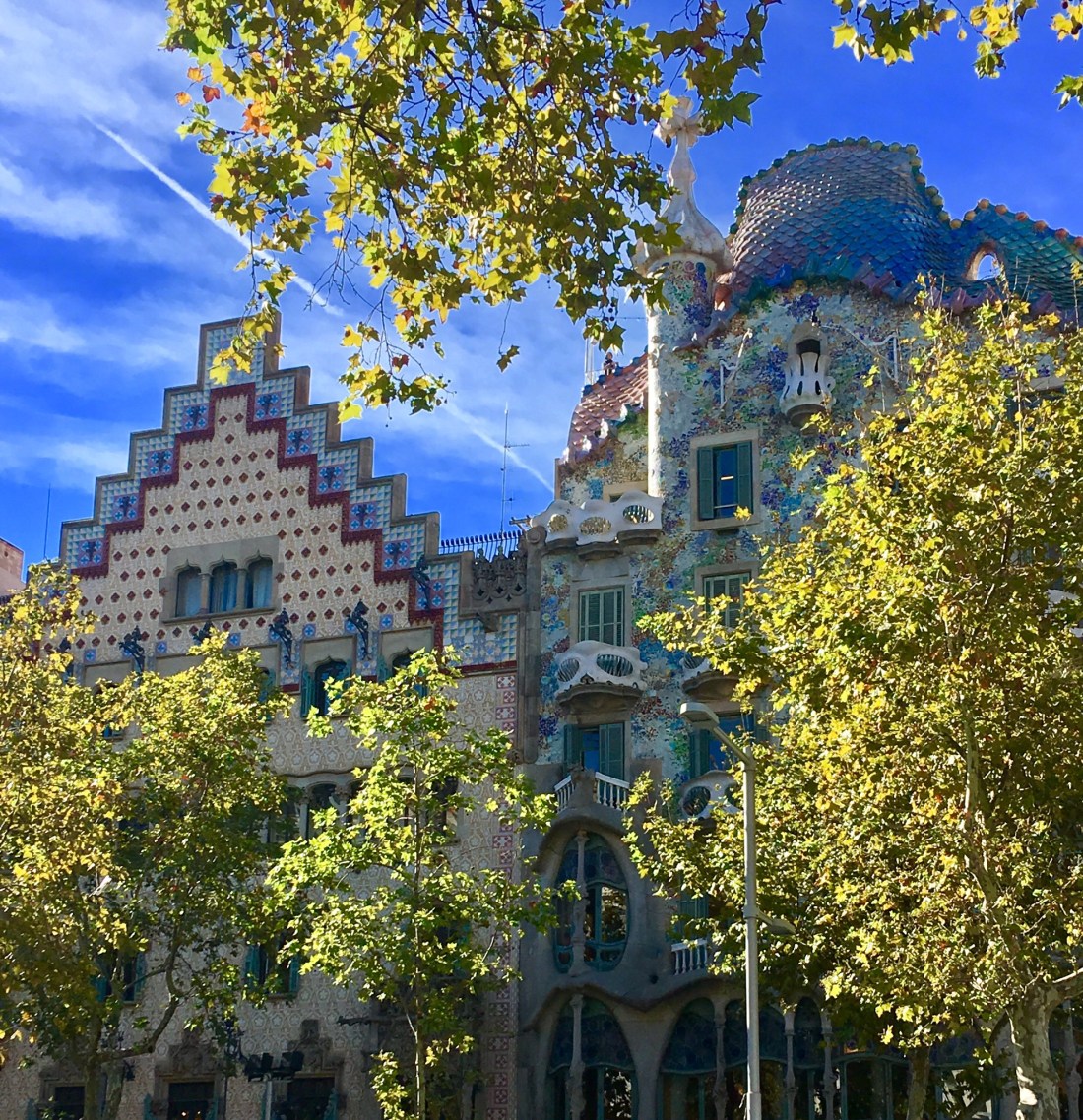
We toured the house on the right, designed by Gaudi.
One thought on the design of Casa Batllo, is that Gaudi based it on the legend of Saint George and the dragon. Saint George is very popular in Barcelona, and you see images everywhere, and many allusions to his story of slaying the dragon. In fact, the house does remind you of a dragon, from the scales on the roof, to the bannister that resembles a spine. The house has also been called the House of Bones, due to columns that appear bone like.


There are very few straight lines in the building, and everything is sinuous and smooth. Gaudi made sure that everything was ergonomically comfortable as well. The handrails fit perfectly, and the window latches ease nicely under your hand.


I had never understood what the small courtyards were for in many of these building. The audio guide (excellent headphones, and a cellphone type device that if pointed around the room, showed what it origainally looked like furnished) called them lightwells. Windows were on each floor, looking out to the light well, and under many of them were wooden slats that opened and shut for air circulation. They look and function remarkably like gills on a fish. The windows on the top floor were the smallest, with the windows looking out to the well on the bottom were the largest, to gain more light. Gaudi used tile in all shades of blue to defuse and reflect the light – lightest on the bottom, to darker on the top – and the stairway that opened into the well in places, had undulating banisters, and frosted, waves glass walls. The effect was to mimick that on being under the sea.


The attics had arches, forming the structural frame work, and Gaudi used these for the laundry rooms, furniture storage and the like. The chimneys on the roof were tiled, and were bundled together in order to create an artistic effect. They also had hoods over the top, an innovation that Gaudi invented. Both the roof and the terrace (4 stories below) are uneven, and slightly undulating, making them great for water drainage, but a little unsettling to walk on.


One of the more unusual fixtures was the ceiling and light in the main sitting room. It made the whole room seem to move, and seemed like water moving sand.

Needless to say, I was in building heaven, and the tour was worth every penny. Tomorrow we have tickets for Sagrada Familla, the Cathedral designed by Gaudi, which is still under construction.
This afternoon, when we were supposed to be packing (and doing everything we could to avoid it), Sharon asked me if I’d looked into any needlework stores in the area. I said no, and promptly did so, and it turned out that there were several. One is particular was directly behind our hotel in the next alley. How convenient!
Of course I was ready to head out immediately. The Merceria Santa Anna was located on the alley just behind ours, so off we went. We we turned onto the alley, Sharon asked it I was sure, because it was deserted, dark, and somewhat formidable looking. But halfway down, there it was. A bright doorway. It turned out to be packed with both goods and people. Buttons filled one wall, with cards of samples in front. It looked they had the full lines of both DMC and Anchor floss and perle cotton. There was a wall of yarns, knitting needles and crochet hooks and patterns, and sliding panels of ribbons and notions. There were also about 15 sales people helping a full load of customers. I did find what I was hoping to find – an unusual selection of trims for the small business I’m in the process of setting up, making one of a kind bags. I showed the sales woman a picture of one, and she immediately started pulling out books with amazing trims! She spoke no English, and I spoke no Spanish, but we managed to communicate just fine. It was an amazing experience.


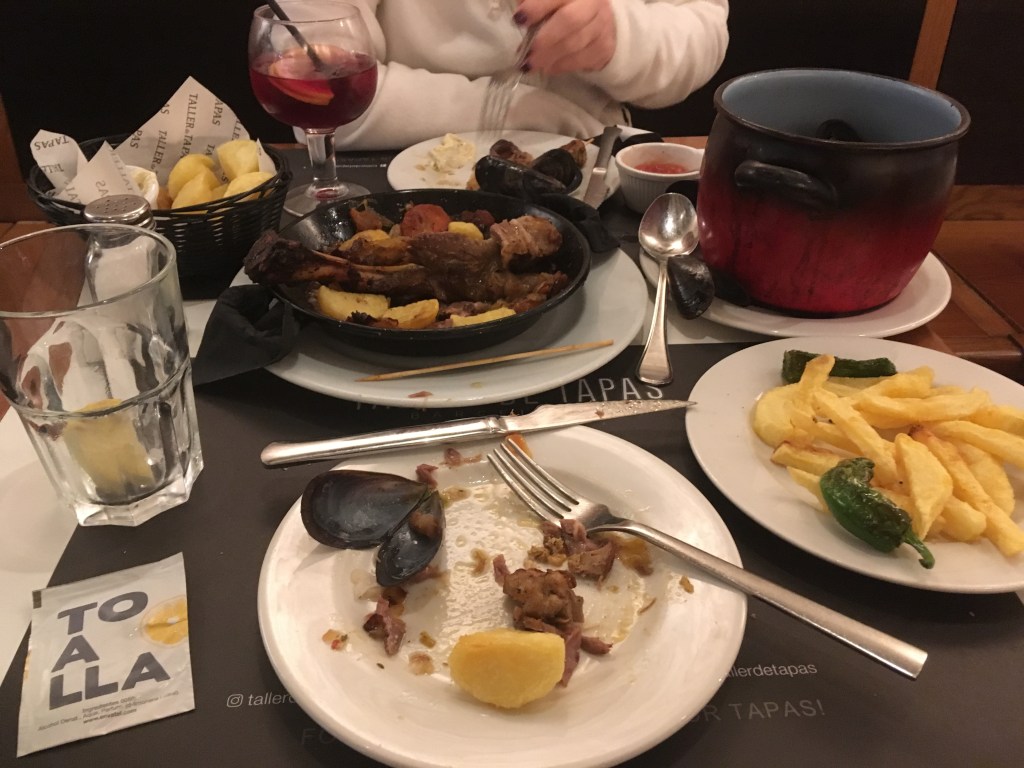
Dinner tonight was another first. I’ve never had Tapas, a very popular Spanish meal. Tapas are small, appetizer type, bite size morsels. They can be served on a bar, where you point at something, and you pay just for what you eat. Or, in the way we had it tonight. Small portions served family style, like an American Chinease restaurant. We ordered too much. Calamari, Lamb, Mussels, Chicken kebabs, Cod, and a bread totased with olive oil and served with a really good fresh tomatoe spread. The lamb or mussels alone would have been a whole meal! I don’t usually talk about food, or take pictures of my meals, but here is our Tapas feast, about 3/4 gone. I did order desert – an almond tart with cinnamon ice cream. Everything we ordered was just terrific. The spices were different, and not overly strong, just enough for flavor. The whole meal was a real treat.
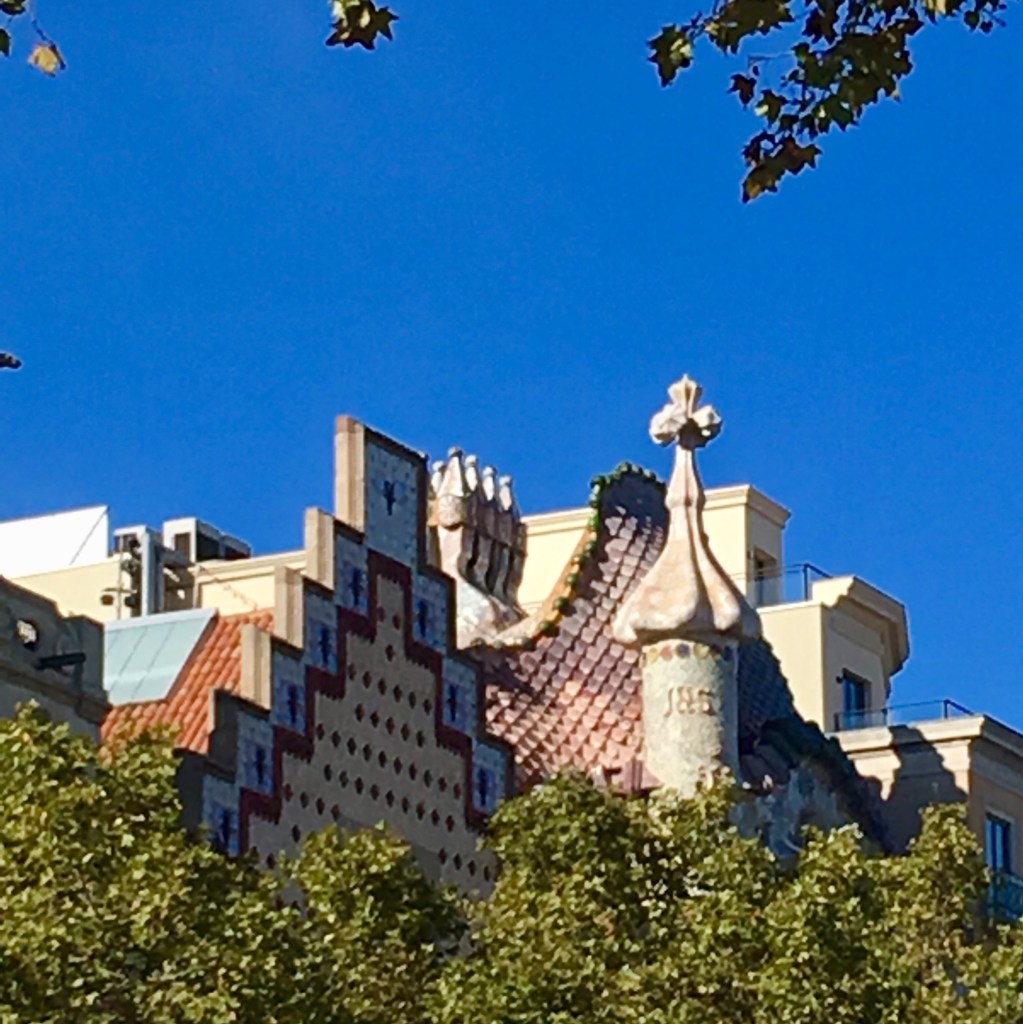
That wraps up today. As always, random pictures follow.





 Suzanne’s Travels
Suzanne, did any of the needlework stores in Barcelona have painted needlework canvases? I am visiting in April and like to work on local designs.
LikeLike