
Today we visited Sagrada Familia. I’m not quite sure where to start on this one. Basically, the Sagrada Familia is a Basilica, and the name means Sacred Family. Antoni Gaudi designed this church, felt it was his true life’s work, and he is currently buried there. It was begun in 1882, and has continued ever since. It is slated to be completed in 2026. It is funded only by individual donations, ticket sales, and proceeds from tours.
The design is complex, with four facades. Each will show a part of Christ’s life. The nativity facade is completed, as is the crucifixion. Each part of the building has some kind of symbolic significance. There is a lot about the design and the symbols out online, if you wish to follow up on it.
To see the outside is to see a work in progress. Not only that, it is a building that is nearly impossible to comprehend. You have to look at it in pieces, not as a whole.
The crucifixion scene is stark and hard. Gaudi indicated that he wanted it to look like bones, and the effect is uncannily accurate. It is a scene of hard plains, and few curves. The statues are all angles. The awning over the scene does indeed look like a fence of bones.


The opposite side, the Nativity, is completely opposite. It looks as though it is melting. Everything is busy with curves, and leaves, and curlicues. It’s hard to make sense of what you see as there is so much to take in. Flowers were over the main doors, and the doors themselves were of green leaves, hues moving subtly down to the water lillie’s at the bottom.


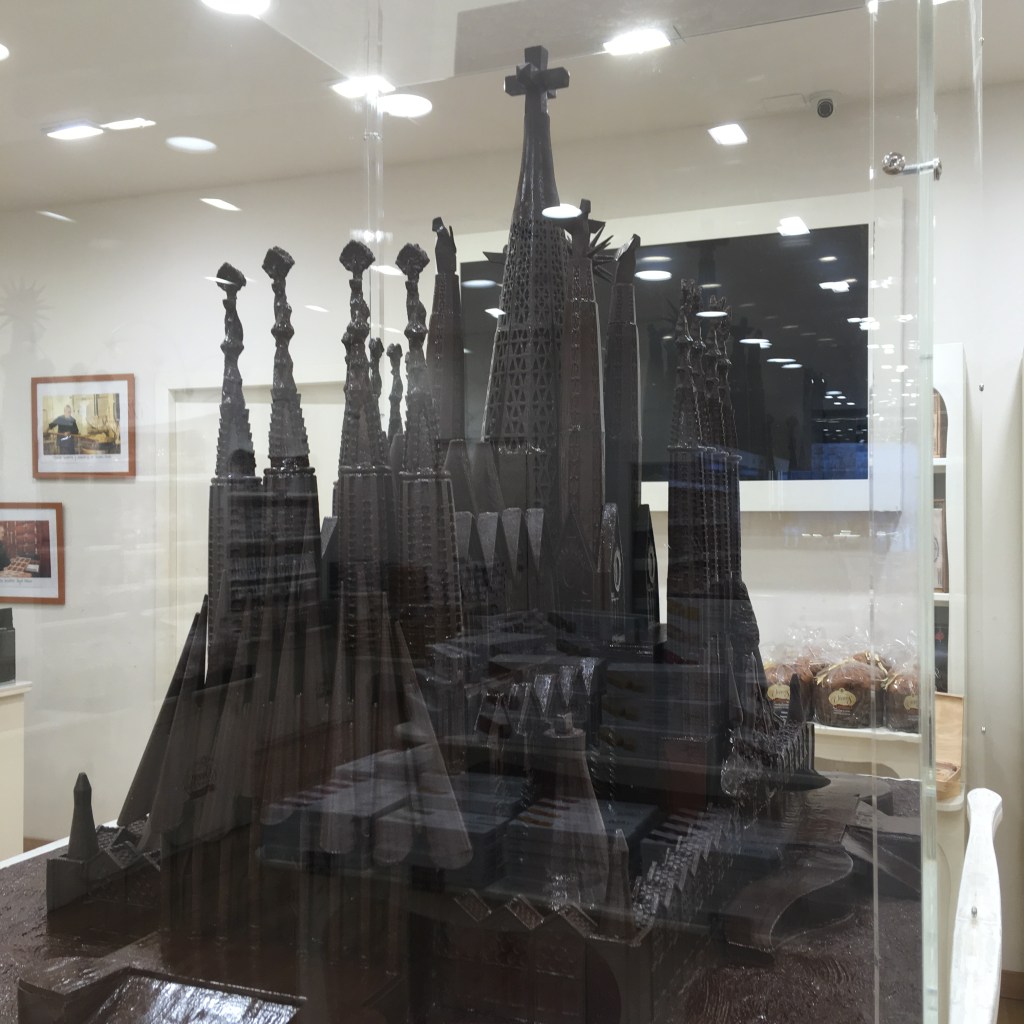
The other thing that comes to mind immediately, is the use of spots of color. At the height of the Nativity, there is a green cypress tree, with doves. On the sides of the church, there are spires crowned with different fruits. I was fascinated, but unsettled by the lack of continuity in the whole. There are models in many shops, but I don’t think I’ll ever see the continuity in the design. (My favorite model was one made of choclate in a candy store.)


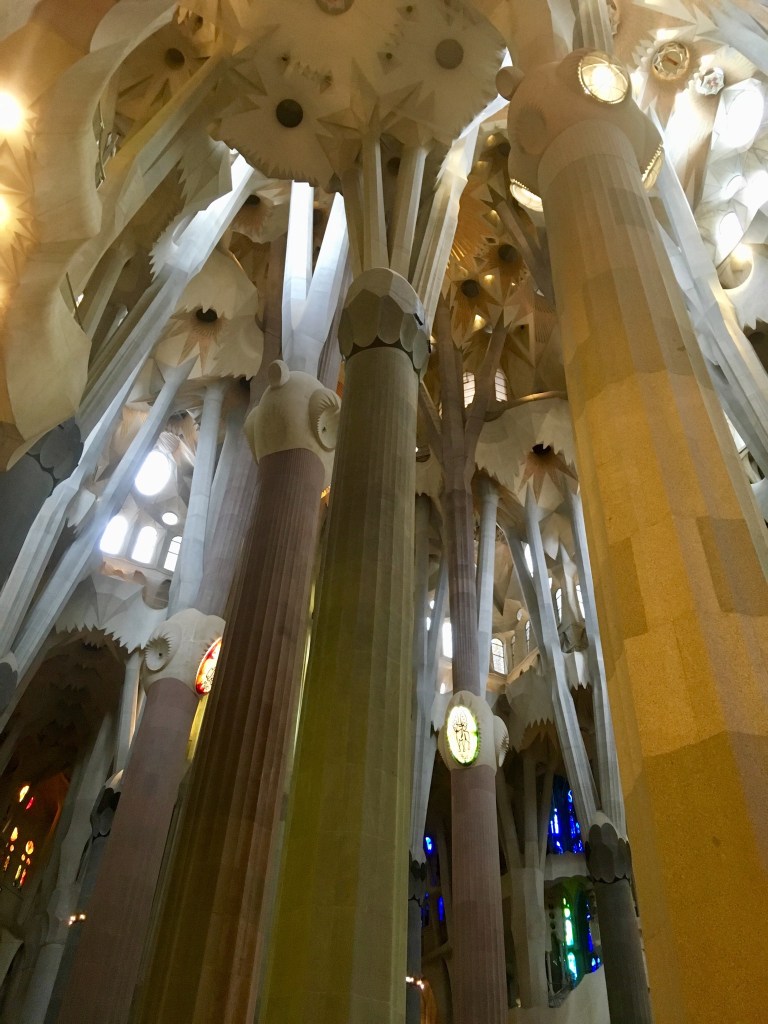
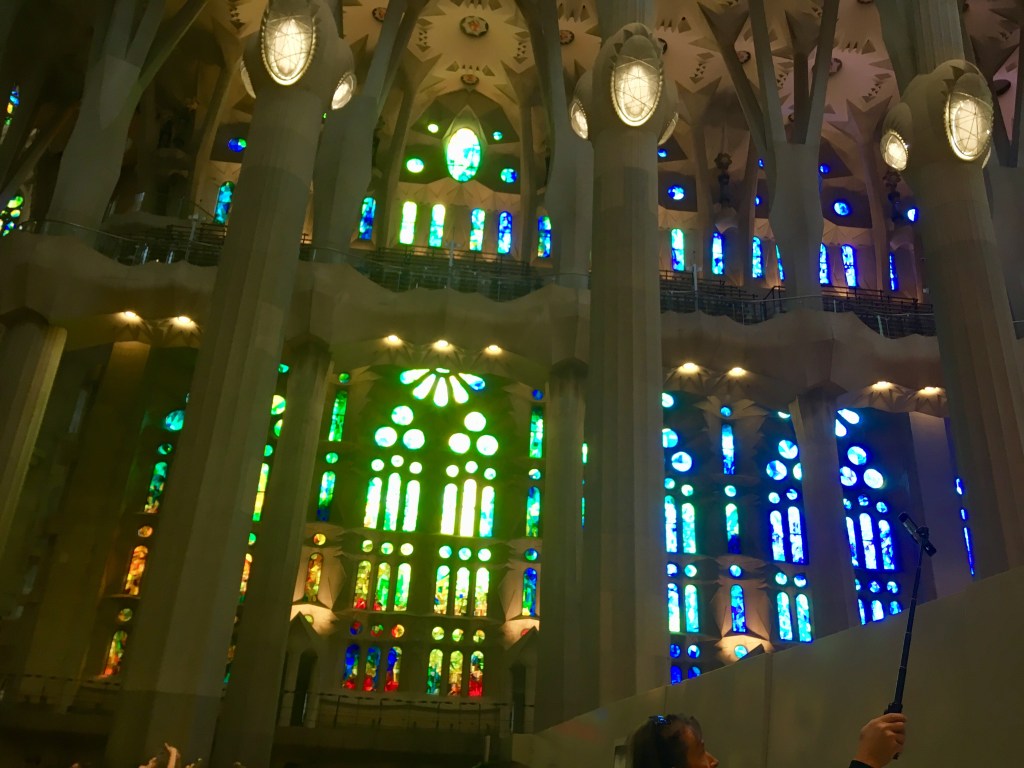
If I was unsettled by the outside, the inside was just as different, but ultimately more tranquil. Everything in the inside was concrete, but of slightly different hues. The pillars were each made to represent a different type of tree, hence different sizes, shapes, colors, etc. The effect Gaudi was after was that of a forest. Again, there were too many places to look, and the lack of order that one would normally find in a church.
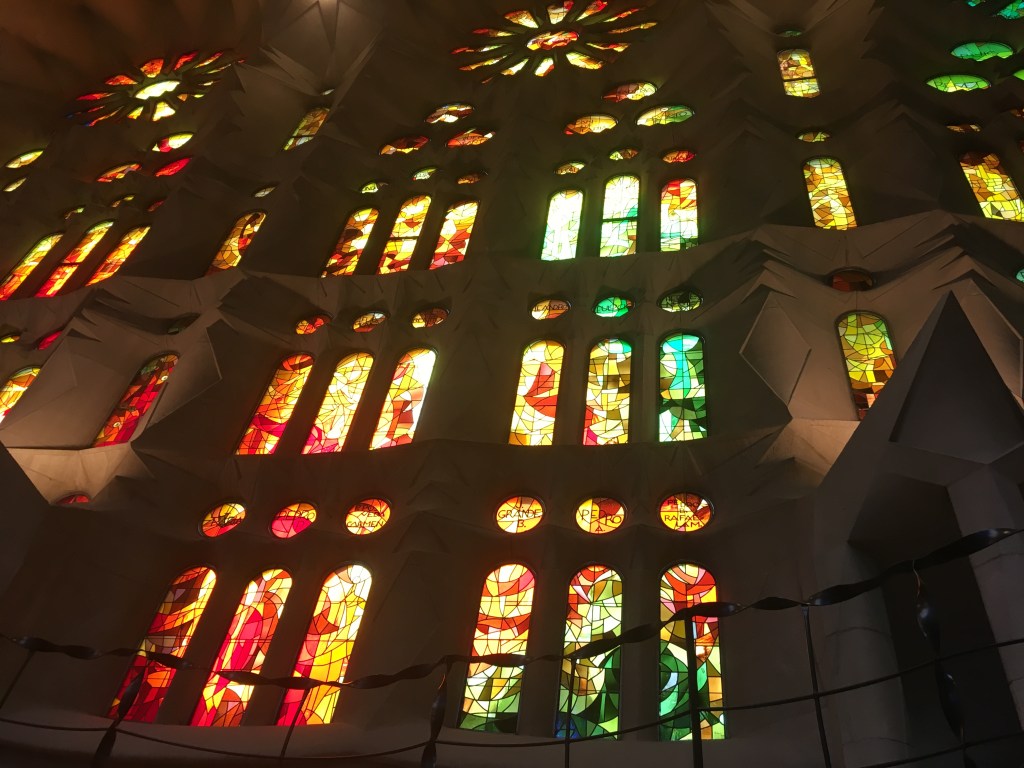
And color was absolutely everywhere. Windows of primary colored stained glass were everywhere, along with a few of stark white. Colors were symbols, and depending on which side you were on, were proportionally different. Christ’s nativity was blues and greens, with limited reds and oranges, yet the passion facade was just the opposite.
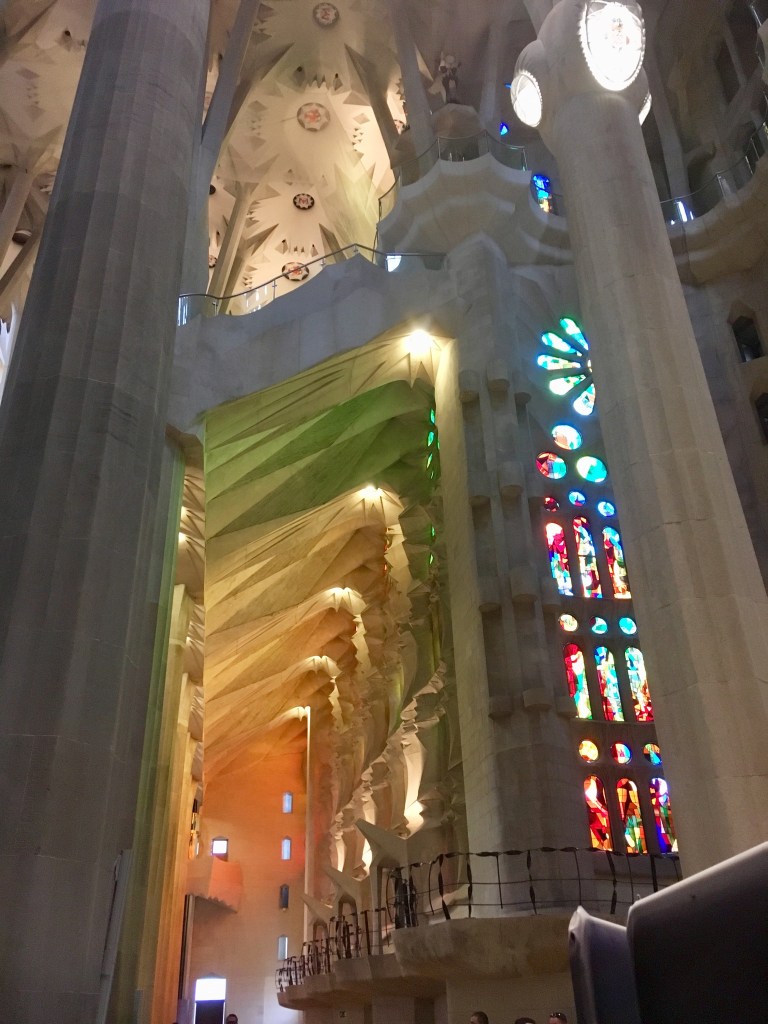
Staircases were circular, and even the elevator was circular. Like the Casa Batllo we toured yesterday, everything reflected nature. Balconies were curved, railings were narrow ropes of wrought iron, some with dots like musical notes, and light flooded everything.


Gaudi’s Sagrada Familia is incredibly difficult to describe. It’s moving, and it’s unforgettable, like much of his work. Antoni Gaudi is the type of man who would either have been considered completely mad, or an absolute genius. I’m glad the world has recognized his unique view of the world.
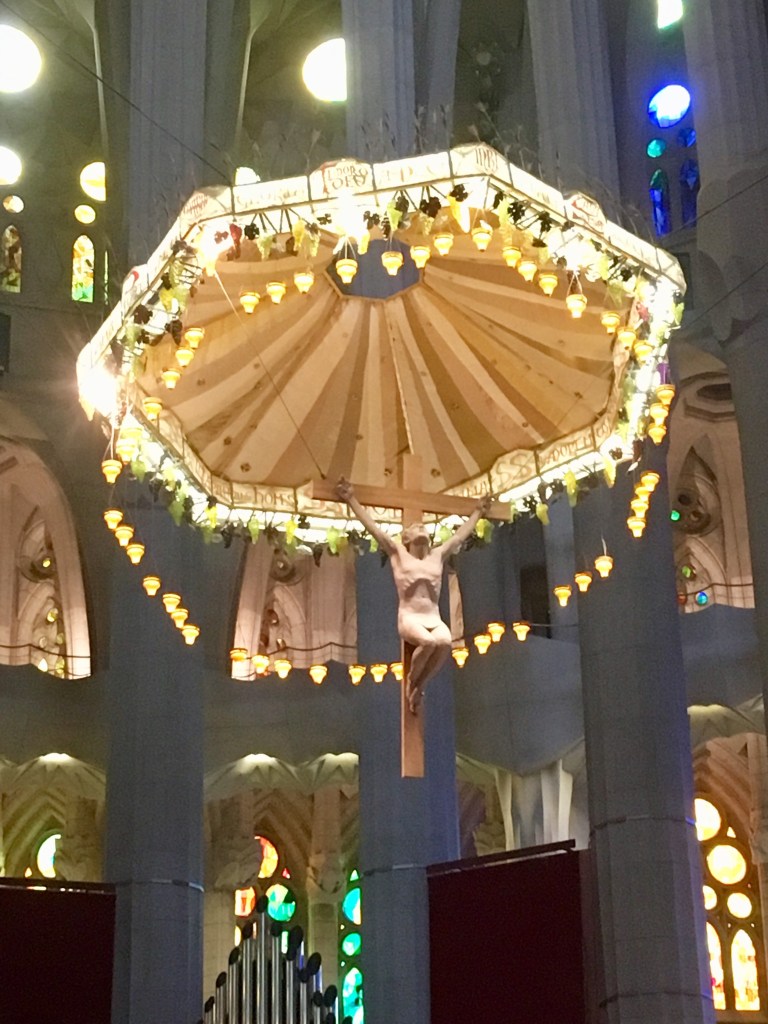
We’ve visited several important churches on this trip. And some very, very famous. They have all been so different. Saint Peter’s in the Vatican, with the giant awning over the alter and Saint Peter’s grave. Every surface decorated, covered in gold leaf, painted, and illuminated with all that is prescious and costly. A work of art in every inch. Barcelona Cathedral, stone and age, and built to reach the heavens in a time when that type of engineering seemed far out of reach, but still seems to accomplish it, in it’s great age. Monserrat, with it’s isolation and mystery, the moorish patterns, inlaid floors, and the glorious shrine encasing the Black Madonna. And finally, Gaudi’s view of the Bible outside, and a forest of his own creation inside.
Each of these has one thing in common. Each was built to glorify God, and to try to recreate heaven on earth, and honor God. All people have a different view of this majesty, but each seems to include a large scale, and towers reaching for the skies. The engineering in each of these buildings is glorifying to God as well. He has given the builders the knowledge to reach beyond what they had known before, to strive for bigger, greater, richer. But thankfully God does not need a building, or grandeur, or all that is precious. He is content to dwell within each of us, eliminating the need to builder greater buildings. Yet the incredible beauty created in each of these unique buildings remains, and each great church reflects that desire to glorify God, and that is never wrong.
This is rather picture-heavy, but it was hard to narrow down what to include!
Nativity Facade:


Miscellanous shots of the outside of the Basilica:


Pictures of the area inside the church, but surrounding the scantuary:


Several shots of the interior:








 Suzanne’s Travels