
Tonight we attended a flamenco performance at the Paleau de la Musica. Perhaps this wasn’t the brightest thing to do on our last night, as the show started at 9pm, and we didn’t get back to our hotel until 11. Not bad, except we had a wake up call at 3am for a early flight out of Barcelona.
But it was worth it!
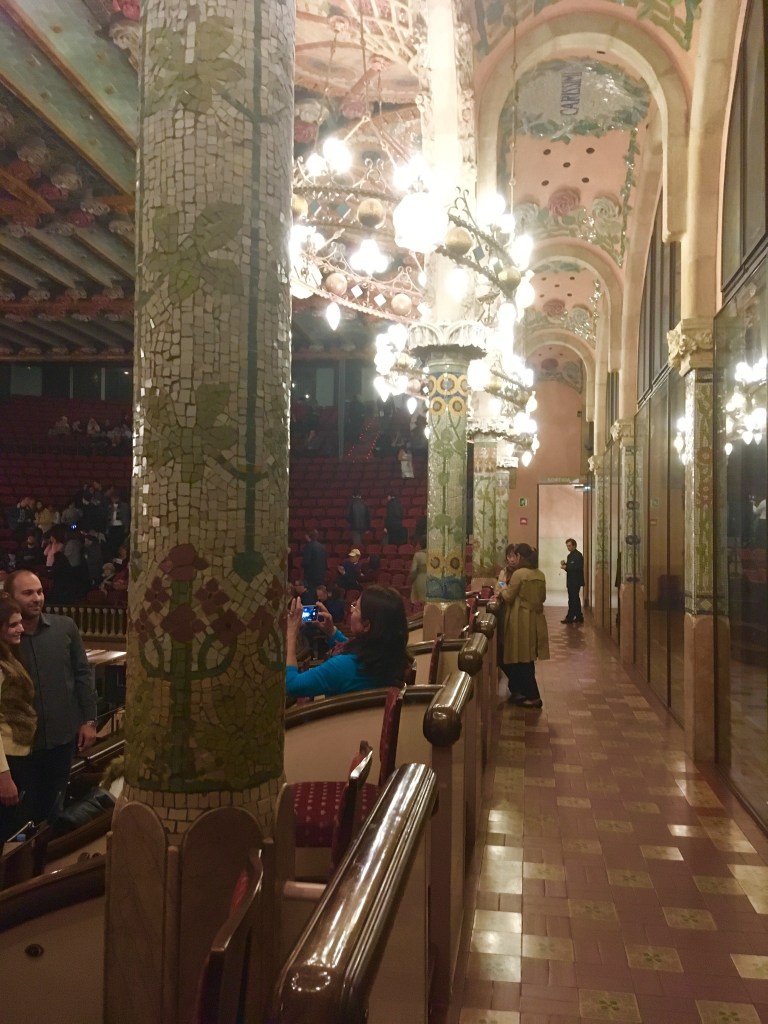
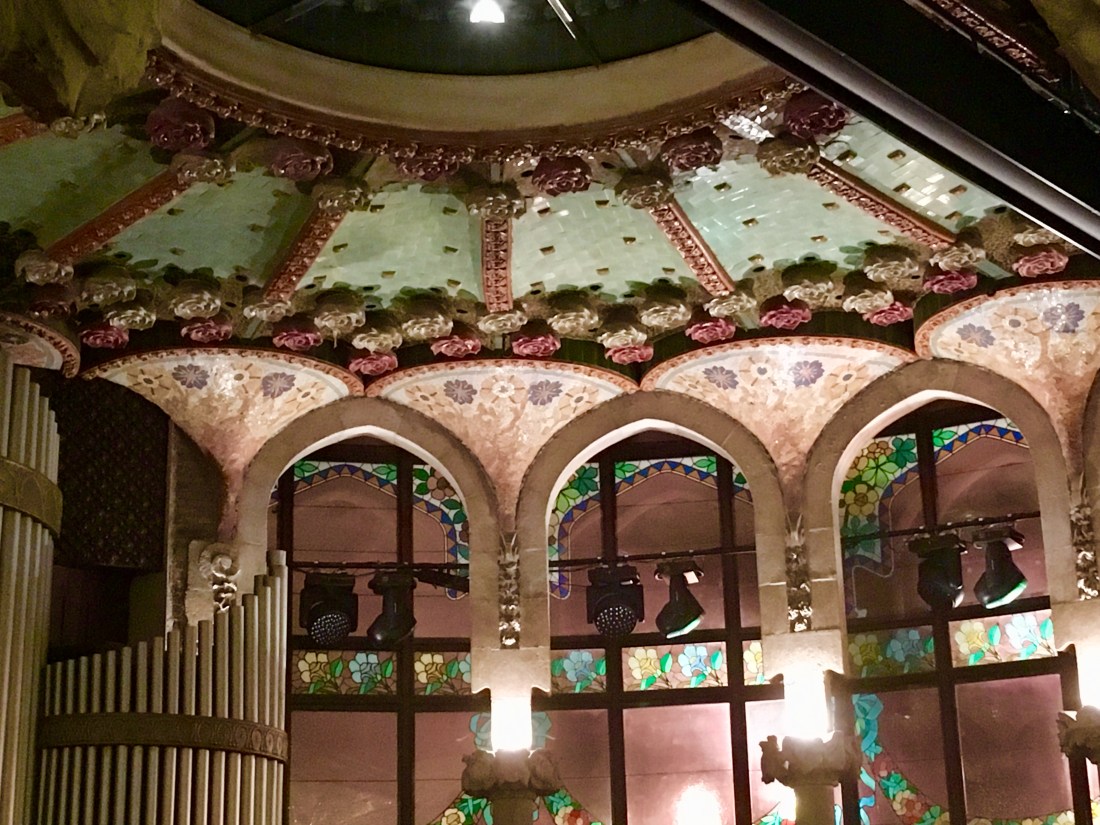
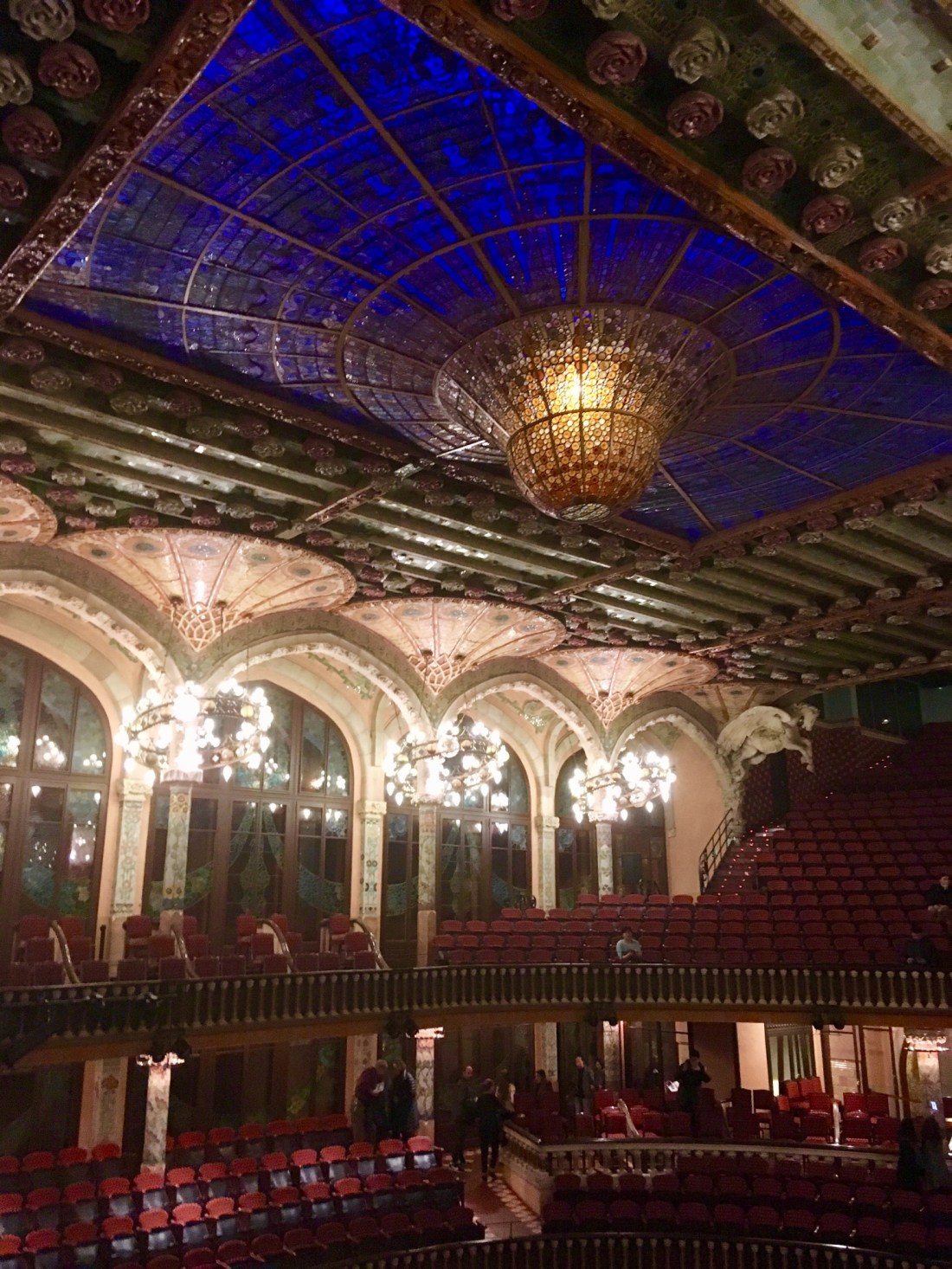
First, the building. The Paleau de la Musica is a gem of a building. It opened in 1908, and was listed as an USESCO World Heritage Site in 1997. The architect was Louis Domenech. We’d seen the outside, and I posted pictures of it on Day 12, but as always, the inside was marvelous and different.


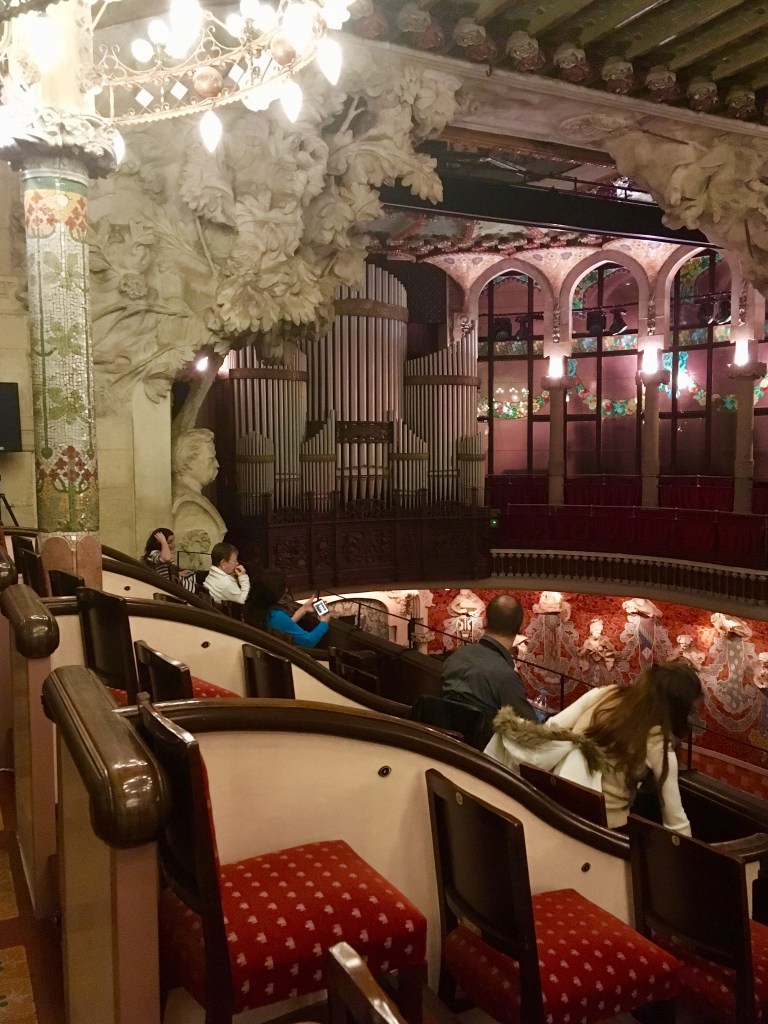
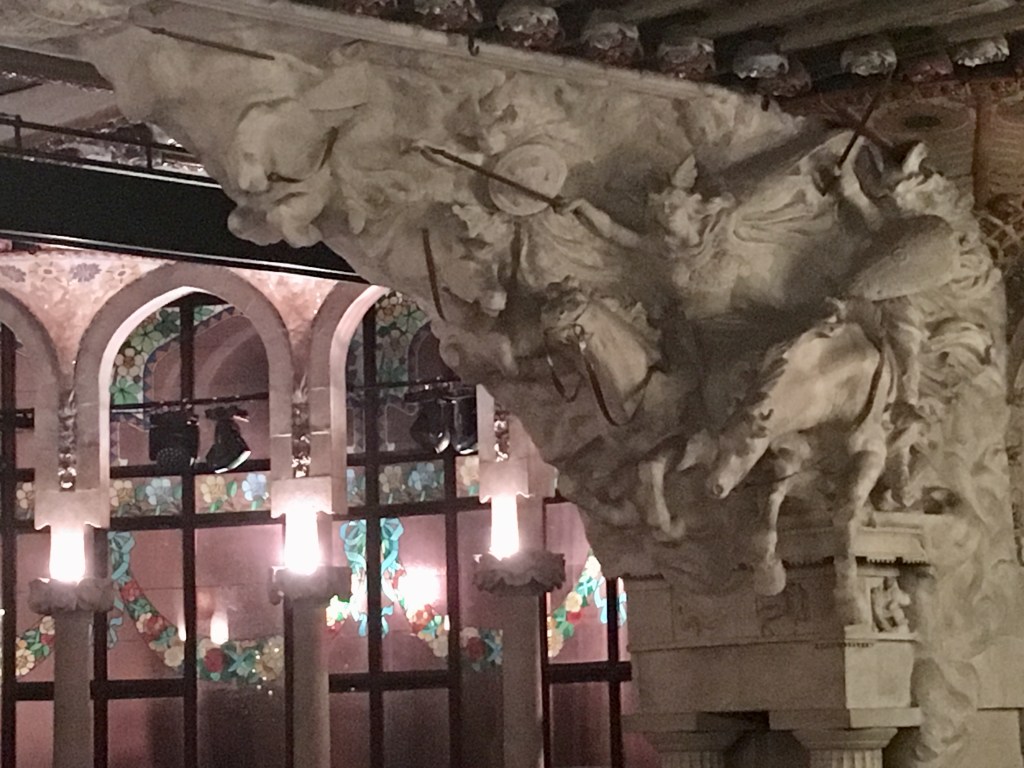
The building has all of the hallmarks of a Moderist building, including Mosaic pillars,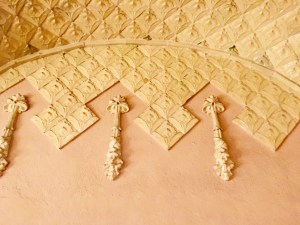 and stained glass. And in fact, there is a lot of tile, but also a lot of ornaments in plaster. It truly looks like the inside has been frosted. It was built to honor Catalonia music, but it honors music from all over, with busts of the great composers, and names in tile on the ceiling.


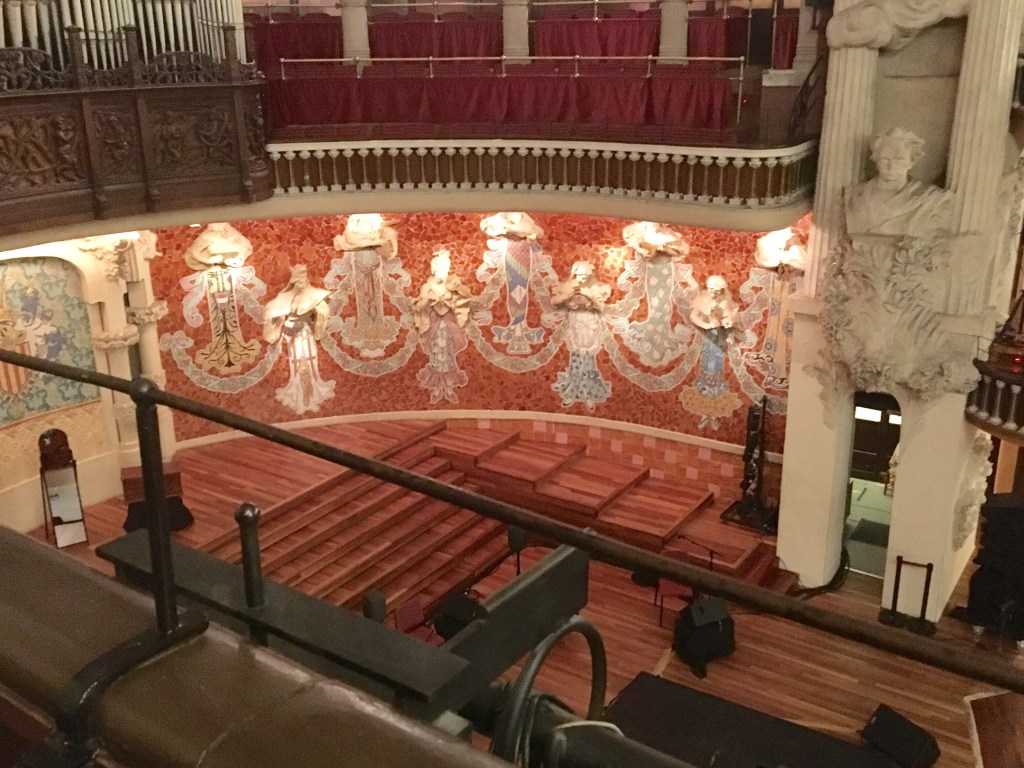
We sat up on the top side balcony, next to the stage. It was a box, with chairs, not stationary seats, that we see today, and were in most of the hall. The floors were hardwood, and we had to be careful not to shift, as the chairs scraped on the floor loudly. We looked down onto the amplified floor, and it was an amazing view to see the show. I could look right into one of the wing entrances and see the dancers waiting to come onstage, composing themselves, then making their entrance, and a sound man coming to communicate with the musicians.
The performance itself was ‘Arte Flamenco’, and featured a selection of dances. The program below has been taken from the website of the Palace of Music program
PROGRAM
TANGOS: One of the most basic dances “palos” of flamenco with “copla”.
ALEGRIAS: One the most lively songs in flamenco.
TANGUILLOS: A festive dance, happy and flirtive. One particularly notices the use of feet.
SOLEA POR BULERIAS: It’s the basis of the strongest rhythms in flamenco.
SEGUIDILLAS: One of the oldest songs and saddest.
BULERÍA: A lively flamenco song accompanied by guitar
BALADA (SOLEDAD): romantic palo
GARROTIN: Flamenco dancing born outside Andalusia with a lively rhythm of tango
Of course, I couldn’t understand a word of what was sung, but all of it was truly amazing. The singers and musicians were ranged in a semi circle around the amplified floor. The music and the dancing went hand in hand, and often, the singers would stand and join the dancers. I was interested to note that the performance seemed somewhat freeform, like European folk music, blending seamlessly together. Much of the singing was accapella, and it was somewhat difficult for those of us with a European classical music education to understand where a piece ended. There was no conductor, and quite a bit of discussion between the participants, some tuning of the instruments, the right into the piece with no identifiable transition. As such, it was an organic presentation, coming from the heart and soul, and not a written piece. There were no scores of music, just musicians and dancers performing. I wonder how much of it, again, is like folk music, and is never exactly the same twice.
it was a complete treat to watch the dancers use the trains of their dresses as an integral part of the performance, deftly kicking them out of the way, or twisting them in front as they danced. Hands were always moving, snapping, or welding fans, scarves, or hats, with precision and grace. And the rhythm always carried out by feet tapping or stomping on the floor, and clapping rhythms from the singers. It was wonderful, and so very worth seeing.
Some of the movements seemed to be reminiscent of the moves that matadors would use when bull fighting as well. The erect posture, stylized stances, and planned, angular gestures. I’m sure that is not a coindence. Barcelona has outlawed bull fighting, but it is part of its history, and music and dance express that history. The whole program expressed raw emotion, controlled and calculation, but deep and passionate. It was riveting to watch. The Catalonian’s are proud of their musical heritage, and very justly so.


After the performance, we walked the few blocks home to our hotel. It was Friday night, and there were as many people out as during the day. Barcelona is a lively place.
We made all three of our flights easily (although 3am Saturday morning was a tough wake up time!), and although we travelled for something like 30 hours all told, we arrived back near home at 10:30pm Saturday, with all the time changes.
It was a great trip, and it’s going to take awhile to absorb everything I’ve seen and experienced. I look forward to reading more about Moderist Architecture, and the movement around it. Between Ancient Rome, Art Nouveau, and the cruise ports, we saw and learned a lot. Travel is wonderful, and it makes you think. Now I want to know more, and that’s as it should be.





 Suzanne’s Travels